Universal Cassation Jurisdiction in International Law: Is the World Moving Towards a New Court of Justice?
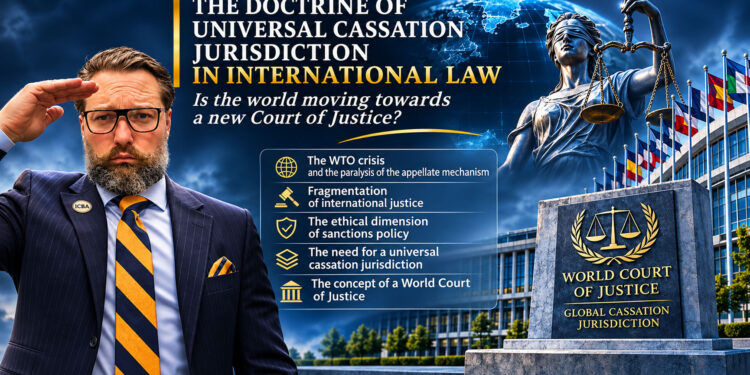
By Oleksiy Shevchuk
The growing fragmentation of international judicial systems, the crisis of the World Trade Organization’s appellate mechanism, disputes surrounding international sanctions and challenges to the enforcement of international judicial decisions raise fundamental questions about the future of global justice.
The international legal order increasingly faces a structural problem: while specialized judicial institutions continue to develop within their respective areas of jurisdiction, there is no universal mechanism designed to address certain fundamental inconsistencies in the application of international law.
In this context, the need to reconsider the institutional architecture of international justice becomes increasingly apparent.
I propose initiating an international legal and academic discussion on the Doctrine of Universal Cassation Jurisdiction in International Law — a concept aimed at establishing an additional level of judicial oversight to safeguard fundamental legal principles and strengthen consistency across international jurisdictions.
1. The World Trade Organization: When International Justice Becomes Dependent on Politics
For decades, the World Trade Organization (WTO) has been one of the principal institutional mechanisms governing international economic relations.
Its dispute settlement system enabled states to resolve trade disagreements through legal procedures rather than relying exclusively on political pressure, unilateral restrictions or economic retaliation.
The WTO Appellate Body played a particularly important role by reviewing legal findings issued by dispute settlement panels.
However, since December 2019, the Appellate Body has been unable to function because of the lack of the required number of members. The United States has played a central role in this institutional crisis by blocking appointments and raising concerns about the Appellate Body’s interpretation of WTO agreements and the scope of its authority.
The European Union and other participating states subsequently developed the Multi-Party Interim Appeal Arbitration Arrangement (MPIA) as a temporary alternative.
Although this mechanism provides an important solution for participating members, it does not restore a universal appellate system covering all WTO members.
The situation raises a fundamental question: can an international judicial institution gradually develop interpretations that exceed the authority originally delegated to it by states, and what mechanisms should exist to address such concerns?
The WTO experience demonstrates that international justice requires not only substantive legal rules but also sustainable institutional mechanisms.
2. Ukraine, Russia and the Importance of International Economic Justice
For Ukraine, international trade dispute settlement mechanisms have historically been particularly important.
Trade disputes with the Russian Federation were not merely economic disagreements. They formed part of a broader political and international legal confrontation.
One significant example was WTO dispute DS512 concerning Russian restrictions on the transit of Ukrainian goods.
In 2019, a WTO panel examined Russia’s invocation of national security exceptions under the General Agreement on Tariffs and Trade.
The case raised important questions concerning the limits of judicial review when states invoke national security interests.
Although the panel’s findings were not in Ukraine’s favour, the proceedings demonstrated the importance of having an international legal forum in which states can challenge restrictive measures imposed by other states.
When such mechanisms become ineffective, international economic relations risk returning to a system increasingly governed by political pressure, unilateral measures and economic retaliation.
This represents a broader challenge to the international rule of law.
3. Fragmentation of International Justice: A World Without a Unified Legal Framework
International justice currently operates through a complex network of specialized institutions.
The International Court of Justice addresses disputes between states. The International Criminal Court exercises jurisdiction over individuals accused of specific international crimes. The European Court of Human Rights protects rights guaranteed by the European Convention on Human Rights. The International Tribunal for the Law of the Sea addresses disputes concerning maritime law, while investment arbitration mechanisms resolve disputes between investors and states.
Each institution operates within its own jurisdiction, procedural framework and system of legal remedies.
However, there is no universal international cassation institution empowered to address exceptional inconsistencies in the application of fundamental principles of international law across these different jurisdictions.
This fragmentation creates several challenges:
- Different international courts may interpret general principles of international law differently.
- Mechanisms for reviewing judicial decisions vary considerably between institutions.
- There is no universal procedure for addressing certain systemic conflicts between international legal regimes.
- Fundamental jurisdictional or procedural violations may remain difficult to challenge once existing review mechanisms have been exhausted.
The principle of finality is essential to legal certainty. Nevertheless, the relationship between judicial finality, procedural fairness and exceptional legal oversight deserves further international legal discussion.
4. The Doctrine of Universal Cassation Jurisdiction in International Law
The central proposition of the Doctrine of Universal Cassation Jurisdiction in International Law is the development of international legal foundations for a universal cassation institution capable of conducting limited reviews of certain decisions issued by international judicial and quasi-judicial bodies.
This proposal does not envisage replacing the International Court of Justice, the International Criminal Court or other existing tribunals.
Nor does it seek to establish an additional ordinary appellate level for every international dispute.
Its purpose would be to provide an exceptional mechanism for safeguarding fundamental legal principles, reviewing jurisdictional boundaries and addressing serious procedural deficiencies.
Potential grounds for cassation review could include:
- Fundamental violations of the right to a fair trial.
- Substantial excess of jurisdiction by an international judicial institution.
- Serious violations of essential procedural guarantees.
- Systemic inconsistencies involving the application of peremptory norms of international law.
- Exceptional conflicts in the interpretation of general principles of international law affecting the international legal order.
Such jurisdiction must remain exceptional, subsidiary and based on an international treaty.
Most importantly, it cannot be established without the consent of participating states and appropriate coordination with the founding instruments of existing international judicial institutions.
5. Is a World Court of Justice Possible?
One possible institutional expression of the proposed doctrine could be a body provisionally referred to as the World Court of Justice.
Its purpose would not be to establish universal political arbitration or reconsider every international judgment.
Instead, it would exercise legally limited cassation jurisdiction over specifically defined categories of decisions.
The institution could be established through a separate multilateral international convention. Participating states would determine the scope of jurisdiction, admissibility requirements, review procedures and legal consequences of its decisions.
In the longer term, specialized chambers could be considered for international public law, international economic law, human rights and other areas of international legal practice.
However, the relationship between such an institution and existing international courts would require particularly careful legal consideration.
For example, Article 60 of the Statute of the International Court of Justice establishes the finality of its judgments. The Rome Statute also provides its own appellate procedures for the International Criminal Court.
Consequently, a new institution could not automatically acquire authority to review decisions of these courts without an appropriate international legal basis and the necessary consent of states.
International criminal justice would require especially strong safeguards concerning the rights of defendants and victims, the finality of judgments and the prohibition of double jeopardy.
6. Sanctions Policy and the Ethics of International Coercion
Another important dimension of the proposed doctrine concerns the legal and ethical foundations of international sanctions policy.
Sanctions have become one of the principal instruments of international influence. They include financial restrictions, asset freezes, trade prohibitions, restrictions on access to technology and targeted measures against individuals and entities.
However, different sanctions regimes have distinct legal foundations.
It is necessary to distinguish between United Nations Security Council sanctions, autonomous restrictive measures imposed by states and international organizations, lawful countermeasures and economic restrictions whose legality remains disputed.
The proposed doctrine raises the possibility of developing an international Sanctions Fairness Test.
Such a framework could assess five fundamental criteria:
- Legality of the restrictive measures.
- Adequacy and sufficiency of the supporting evidence.
- Proportionality in relation to the stated legitimate objective.
- Compliance with procedural fairness requirements.
- Availability of effective judicial protection and review.
The objective would be to reconcile the effectiveness of international sanctions with the fundamental requirements of the rule of law.
Any such review, however, would remain subject to the jurisdiction specifically conferred upon the proposed institution.
7. State Sovereignty versus Universal International Justice
One of the most significant challenges to the proposed doctrine concerns the relationship between state sovereignty and universal international judicial oversight.
International law traditionally relies on the consent of states to international obligations and their recognition of the jurisdiction of international courts.
Therefore, universal cassation jurisdiction cannot be based on the compulsory subordination of all international judicial institutions to a single authority.
Its legitimacy would have to derive from a multilateral convention defining jurisdictional limits, institutional independence, judicial appointment procedures and the legal effect of its decisions.
It would also be essential to establish safeguards against political obstruction.
The experience of the WTO demonstrates that even a sophisticated institutional framework can become ineffective when its functioning depends on political consensus that cannot be achieved.
A future international cassation institution would therefore require sustainable procedures for appointing judges, transparent financing and guarantees of institutional continuity.
8. Does the World Need Another International Criminal Court?
In my view, the question should be framed more broadly.
The international community does not necessarily need another international criminal court duplicating the jurisdiction of existing institutions.
The International Criminal Court already has its own appellate framework. Moreover, contemporary international criminal justice faces challenges involving jurisdiction, state cooperation, enforcement of arrest warrants and the effective implementation of international criminal responsibility.
Creating another judicial institution would not automatically resolve these problems.
What may be needed is an institution of a different nature: a universal international cassation court designed to strengthen consistency in the application of fundamental legal principles across different international jurisdictions.
This represents a fundamentally different approach to international justice.
9. From Institutional Crisis to a New Architecture of International Law
Following the Second World War, the international community established a system of institutions intended to promote peace, security, economic cooperation and the peaceful resolution of international disputes.
The United Nations, international financial institutions, trade organizations and international courts became the foundations of the post-war international order.
However, the contemporary world differs significantly from the international environment of the mid-twentieth century.
Geopolitical competition, digital economies, transnational corporations, sanctions regimes, hybrid conflicts and new forms of economic coercion create challenges that existing institutional structures were not necessarily designed to address.
This does not mean that the current international system should be dismantled.
Rather, its further development may require new mechanisms capable of ensuring greater coordination and legal consistency between existing institutions.
The conceptual value of the Doctrine of Universal Cassation Jurisdiction lies precisely in this approach: preserving the independence of specialized international courts while considering additional safeguards for the consistent application of fundamental legal principles.
10. Conclusion: Is the World Approaching a New Era of International Justice?
The current challenges facing international institutions demonstrate that the international legal order requires more than the adoption of new legal rules.
It also requires a reconsideration of the institutional mechanisms through which those rules are interpreted, applied and enforced.
The crisis of the WTO Appellate Body, disputes surrounding international sanctions, difficulties in enforcing international judicial decisions and the fragmentation of international jurisdictions are different manifestations of a broader structural challenge.
I therefore propose initiating an international professional and academic discussion on the development of the Doctrine of Universal Cassation Jurisdiction in International Law.
Its potential long-term objective could be the development of an international convention establishing a universal cassation mechanism based on the voluntary consent of states, subsidiarity, judicial independence and clearly defined jurisdictional limits.
Naturally, this concept requires further academic research, comparative analysis of international judicial systems and the development of a detailed treaty framework.
Nevertheless, the development of legal science begins with the formulation of new questions and the exploration of new institutional approaches.
Perhaps the future of international justice will not depend on establishing an ever-growing number of specialized courts, but on creating mechanisms that ensure greater coherence across the international legal system.
Perhaps the world is gradually approaching the need for a World Court of Justice.
Not as a political arbitrator between major powers, nor as an instrument for overturning any unfavorable international judgment, but as an independent international cassation institution designed to safeguard the fundamental principles of international law.
The Doctrine of Universal Cassation Jurisdiction in International Law is an original legal concept proposed by Oleksiy Shevchuk for further academic discussion and international legal development.