Ukraine’s Default in 2026: Could It Happen if Peace Talks Fail, and What Role Does Diplomacy Play?
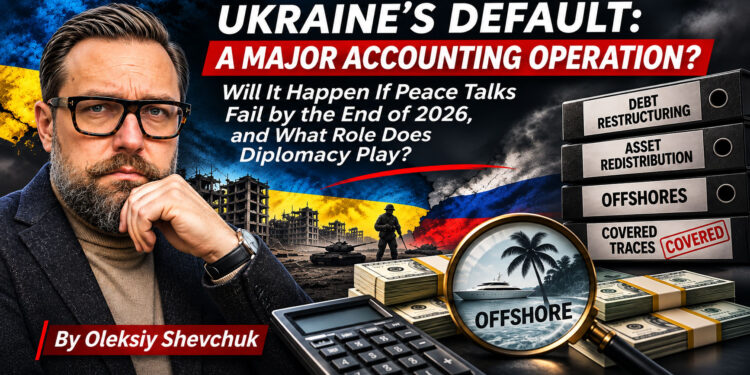
By Oleksiy Shevchuk
Is the prospect of a Ukrainian default becoming another attempt to sweep financial problems under the rug? How real is the risk of a sovereign debt crisis, what could happen in the spring of 2027, and could diplomacy prevent Ukraine from facing another major financial shock?
At diplomatic receptions, people speak about default in hushed voices. Budgets are approved, expenditures are allocated, international partners reaffirm their commitments, yet behind closed doors a different narrative emerges: “We are effectively bankrupt. Nobody just dares to say it out loud.”
An even more intriguing suspicion follows: what if the entire war has become one enormous accounting operation, in which old liabilities are written off, money is redistributed, assets change hands and financial trails gradually disappear?
There are reasons why such suspicions arise.
At the beginning of Russia’s full-scale invasion, Ukraine received military equipment that had been sitting in foreign military warehouses for years. A significant proportion of military assistance also supports the domestic defence industries of donor countries. Debt restructuring inevitably involves the redistribution of financial losses and obligations. Ukraine’s debt burden is gradually shifting from private investors towards governments and international financial institutions.
Meanwhile, frozen Russian assets have become one of the most important instruments of international diplomacy.
It is therefore tempting to interpret these developments as parts of a much larger geopolitical arrangement.
However, an examination of the available documents, international credit ratings and academic research on sovereign defaults reveals a considerably more complicated picture.
Most importantly, a Ukrainian default is not an inevitable consequence of failed peace negotiations. Nevertheless, the financial cost of such a failure could be substantial.
1. Ukraine Has Already Experienced Default. Nobody Hid It.
Let us begin with the facts.
Economic literature recognizes the concept of hidden default. Economists Sebastian Horn, Carmen Reinhart and Christoph Trebesch have examined situations in which governments restructure debt through bilateral arrangements without attracting public attention or triggering conventional rating actions.
Ukraine’s experience was quite different.
In the summer of 2024, international credit rating agencies downgraded Ukraine’s foreign-currency debt into Selective Default (SD) and Restricted Default (RD) categories.
In September 2024, Ukraine completed a restructuring of approximately $20.5 billion in sovereign and state-guaranteed Eurobonds. The transaction reduced the principal amount of debt by approximately $9 billion.
It was a substantial and publicly documented operation, negotiated with creditors and international partners.
The GDP-linked warrants issued following the 2015 debt restructuring presented a separate challenge. In June 2025, Ukraine missed a payment of approximately $0.67 billion on these instruments, triggering further negative reactions from rating agencies.
However, on December 24, 2025, Ukraine announced the completion of the GDP warrants restructuring. More than 99% of participating investors supported the exchange of the existing instruments for new debt securities.
The exchange ratio was 1.34, with the new bonds scheduled to mature between 2030 and 2032.
On January 22, 2026, S&P Global Ratings upgraded Ukraine’s long-term foreign-currency sovereign rating from SD to CCC+, with a stable outlook.
Ukraine had therefore not concealed its default. It had undergone a complex debt restructuring process and returned to a rating category reflecting its capacity to meet certain obligations, although the country remained exposed to very high credit risk.
That distinction matters.
When creditors from around the world vote on restructuring proposals and every major stage is documented by international rating agencies, it is difficult to describe the process as an attempt to hide financial liabilities.
2. Default Does Not Mean Bankruptcy. Although There Are Important Qualifications.
Unlike a private company, a sovereign state cannot be declared bankrupt in the conventional corporate-law sense.
It is not automatically liquidated, and its public assets are not simply sold to satisfy creditors.
In their influential book This Time Is Different: Eight Centuries of Financial Folly (2009), Carmen Reinhart and Kenneth Rogoff demonstrated that sovereign defaults and debt restructurings have been recurring features of economic history.
France, Spain, Germany, Latin American countries and numerous other states have experienced sovereign debt crises.
Default does not mean that a state ceases to exist or that its economy automatically collapses.
Nevertheless, the consequences can be severe: restricted access to international capital markets, higher borrowing costs, reduced investment, pressure on the exchange rate and declining creditor confidence.
Research by Eduardo Borensztein and Ugo Panizza, as well as Juan Cruces and Christoph Trebesch, demonstrates that the economic costs of sovereign default depend substantially on how governments negotiate with creditors, the depth of restructuring and whether prolonged disputes can be avoided.
Ukraine has not repudiated all its debt obligations. Instead, it negotiated changes to the repayment terms of a substantial portion of its external commercial debt, seeking to release resources for defence and essential government expenditure.
In economic literature, this is closely connected to the concept of debt overhang, developed, among others, by Paul Krugman in 1988.
The underlying principle is straightforward: when existing debt obligations become so burdensome that they discourage investment and prevent economic recovery, restructuring may benefit both the debtor and its creditors.
There is another dimension worth considering.
Ukraine is not merely a state with outstanding debt obligations. It is an enormous economic system operating simultaneously as a market, a production complex and, metaphorically speaking, a giant corporation in which different stakeholders seek to protect their own interests.
This is why the statement that “Ukraine is effectively bankrupt” may sound compelling, but is only partially accurate from an analytical perspective.
3. Did Russia Start the War to Postpone Its Own Default or Create One in Ukraine?
This is one of the more intriguing questions, although it is also highly speculative.
Before the full-scale invasion, Russia was not approaching a conventional sovereign debt default.
Its public debt was relatively low, while its international reserves stood at approximately $630 billion at the beginning of 2022.
In 2022, Russia experienced a technical default on certain external debt obligations after sanctions and restrictions on international financial infrastructure prevented payments from reaching creditors through the established mechanisms.
In other words, the war and subsequent sanctions contributed to Russia’s default rather than postponing it.
There is insufficient economic or documentary evidence to support the proposition that Russia launched its full-scale invasion to avoid its own sovereign default or deliberately trigger a Ukrainian one.
However, another question is much more important.
The war has created conditions in which Ukraine’s financial stability increasingly depends on external sources of financing.
That dependence has become one of the country’s most significant strategic vulnerabilities.
4. The Real Problem Is Not a Hidden Default, but Open Financial Dependence
This is where the most difficult part of the discussion begins.
In October 2026, Fitch Ratings affirmed Ukraine’s Long-Term Foreign-Currency Issuer Default Rating at CCC.
The agency projected a government budget deficit of approximately 18% of GDP in 2026, rising to around 28% when grants are excluded.
The prolonged war has also created additional external financing requirements estimated at approximately $27 billion for 2026 and $33 billion for 2027. At the time of the assessment, the sources covering the entire additional financing requirement had not been fully identified.
These are not rumours circulating in diplomatic corridors. They are figures published by an international credit rating agency.
Even more revealing is information published by Ukraine’s Ministry of Finance on September 29, 2026.
According to the government’s assessment, Ukraine’s total external financing requirement for 2027 amounts to approximately $52.6 billion. Of this amount, around $20 billion has identified expected financing sources, while approximately $32.6 billion remains uncovered.
In other words, more than half of the country’s projected external financing requirement for 2027 is not yet supported by confirmed funding sources.
This is a serious reason for concern.
In early November, Ukraine’s Ministry of Finance began discussions with an IMF mission concerning the second and third reviews of the Extended Fund Facility programme. One of the central issues was the 2027 budget framework and the identification of additional sources of international financing.
There is another important indicator.
According to the National Bank of Ukraine’s projections published in November 2026, the consolidated budget deficit excluding grants could reach 37.3% of GDP in 2027.
This is an exceptionally high figure, reflecting the scale of wartime expenditure and the country’s dependence on external resources.
We must acknowledge a fundamental reality: Ukraine’s financial stability now depends not only on domestic economic policy, but also on the political willingness of its international partners.
This is not a conspiracy. It is a fact.
5. The EU’s €90 Billion: Financial Rescue or a New Form of Dependence?
The European Union’s financial support mechanism deserves particular attention.
The Ukraine Support Loan provides for up to €90 billion in financing for 2026–2027.
Approximately €30 billion is intended for budget support, while €60 billion is allocated to military assistance and the development of Ukraine’s defence-industrial capabilities.
One of the distinctive features of the mechanism is that repayment of the principal is envisaged after Ukraine receives reparations or compensation from Russia.
Until then, Russian sovereign assets remain frozen, while the European Union continues to develop mechanisms for using these assets within the framework of European and international law.
This is a significant political and financial decision.
In practical terms, Europe has agreed to assume a substantial share of the financial risk associated with supporting Ukraine, relying on its own borrowing capacity and budgetary resources.
However, there is an important qualification.
The €90 billion does not automatically cover all of Ukraine’s financial requirements. It represents only one component of the country’s overall financing framework.
Ukraine will therefore continue to need additional arrangements with the IMF, G7 countries, the World Bank and other international partners.
This is precisely where diplomacy becomes a matter not of prestige, but of the state’s ability to function.
6. What Could Happen in the Spring of 2027?
In my assessment, the spring of 2027 could become one of the most important periods for Ukraine’s financial system.
However, I would not describe it in advance as a date of inevitable default.
Ukraine is entering 2027 with a substantial budget deficit, significant defence expenditure and external financing requirements that are not yet fully covered by confirmed commitments.
If international assistance is delayed and additional financing sources are not secured, the government could face difficult decisions concerning the allocation of public resources.
Potential consequences could include:
- Revisions to certain civilian budget expenditures.
- Delays in financing selected government programmes.
- Increased pressure on the domestic government bond market.
- Additional tax measures.
- Greater pressure on the foreign exchange market and international reserves.
- Further negotiations with creditors concerning additional financing instruments.
The situation could become particularly dangerous if financing delays coincide with a deterioration in the security environment and declining economic activity.
Nevertheless, three concepts must be distinguished: a budget deficit, a financing gap and sovereign default.
A budget deficit can be financed through international assistance, domestic borrowing and other financial instruments. A financing gap creates a risk of insolvency, but does not mean that default has already occurred.
A sovereign default requires the failure to meet specific debt obligations.
Therefore, the spring of 2027 could bring a serious financial test, but describing it as a guaranteed date of default would be irresponsible.
7. What If Peace Negotiations Fail by the End of 2026?
This brings us to the central question.
Could the failure of diplomatic negotiations become a catalyst for a Ukrainian sovereign default?
It could certainly increase the risks.
However, the reason would not be that the absence of a peace agreement automatically triggers a default mechanism.
The problem is more fundamental.
A prolonged war means continued high defence expenditure, damaged infrastructure, lost production capacity, export restrictions and the need for permanent external financing.
If negotiations fail and international partners begin reconsidering the scale or timing of their assistance, Ukraine could face a dual financial challenge.
On the one hand, it would have to continue financing the war.
On the other, it would need to preserve macroeconomic stability, meet social obligations and service its public debt.
However, the failure of peace negotiations should not automatically be equated with the termination of international assistance.
The European Union has already established a separate financial support mechanism for 2026–2027. Its existence is not exclusively conditional upon the conclusion of a peace agreement by the end of 2026.
At the same time, international support is not unconditional. Financing is linked to reforms, the rule of law, anti-corruption measures and compliance with other agreed commitments.
Consequently, a diplomatic failure could worsen Ukraine’s financial outlook, but it would not automatically produce a sovereign default.
There is another important consideration: diplomacy is not limited to negotiations over a ceasefire or peace agreement.
It also involves negotiations concerning financing, loans, reparations, frozen assets, security guarantees and long-term commitments by international partners.
In practical terms, financial diplomacy has become one of the central components of Ukraine’s national security.
8. Reparations: An Aspiration or an International Legal Precedent?
Personally, I remain rather sceptical about the prospects of Ukraine receiving full-scale reparations.
Not because Russia should escape responsibility for the damage it has caused.
The problem is that there is an enormous distance between the international legal recognition of responsibility and the actual receipt of financial compensation.
History provides grounds for both concern and cautious optimism.
In The Economic Consequences of the Peace (1919), John Maynard Keynes warned that excessive reparations imposed on Germany after the First World War could have devastating consequences for the European economy.
At the same time, other precedents exist.
Following the Gulf War, the United Nations Compensation Commission established a mechanism to compensate Kuwait and other affected parties for damage caused by Iraq. Payments were financed through a portion of Iraq’s oil revenues. The Commission completed its work in 2022 after the relevant compensation obligations had been fulfilled.
Another important example is the 1953 London Agreement on German External Debts, which provided for substantial reductions and restructuring of West Germany’s external debt. This became one of the important foundations of the country’s post-war economic recovery.
The conclusion is straightforward: reparations are possible when an international legal mechanism exists, identifiable sources of compensation are available and there is sufficient political will to enforce the relevant decisions.
However, there are currently insufficient grounds to assume that Russian sovereign assets will automatically become a comprehensive financial resource for Ukraine’s reconstruction.
The EU’s €90 billion financing mechanism represents an important step, but it is not equivalent to a final settlement of the reparations question.
9. The Redistribution of Global Assets Is Happening, but Not in the Shadows
The redistribution of international financial resources is undoubtedly taking place.
We can observe it in decisions concerning frozen Russian assets, new European defence budgets, international lending mechanisms and emerging rules governing financial support for countries at war.
This is a major process with implications extending far beyond Ukraine.
However, I see insufficient grounds to claim that the entire process is a pre-planned operation designed to conceal a default or write off someone’s financial obligations.
The reality is considerably more straightforward, and at the same time more dangerous.
Ukraine requires tens of billions of dollars in external financing every year. International partners are prepared to provide substantial assistance, but that assistance depends on their political willingness, domestic economic circumstances and assessments of the future course of the war.
Therefore, the central question is not when Ukraine will officially announce a default.
The question is who will pay, and under what conditions, for the continuation of the war and the reconstruction that follows it.
10. Conclusion: Default or Diplomacy?
I would not rush to predict a Ukrainian sovereign default at the end of 2026.
A large budget deficit or an uncovered financing requirement alone is insufficient to support such a prediction.
Any serious assessment must consider the actual schedule of international assistance, the government’s ability to meet its debt obligations, the condition of foreign exchange reserves, domestic borrowing capacity and the willingness of international partners to continue financing Ukraine.
At the same time, it would be equally irresponsible to reassure society that international assistance is guaranteed to cover every financial requirement.
The situation remains difficult.
If diplomatic negotiations fail to produce results by the end of 2026, the war continues and international financing is neither increased nor properly aligned with Ukraine’s budgetary needs, the country could face a considerably more acute financial crisis in the spring of 2027.
But that still does not mean that default is inevitable.
Perhaps the greatest danger is not even default itself, but the gradual transformation of the country’s financial stability into an object of international political bargaining.
This is precisely why diplomacy is now just as important as economic policy.
Ukraine needs more than new loans. It needs long-term financial guarantees, a clear framework for the use of frozen Russian assets, workable reparations mechanisms and an international coalition that understands that Ukraine’s financial stability is an essential component of European security.
And, of course, transparency.
The more openly we discuss our debt, financial risks and dependence on international partners, the less room there is for political manipulation and misleading narratives.
Public scrutiny remains one of the most effective instruments available to us.