The Crimean Bridge, the Blockade of Crimea and a Grand Geopolitical Deal: Are We Being Prepared for a Territorial Exchange?
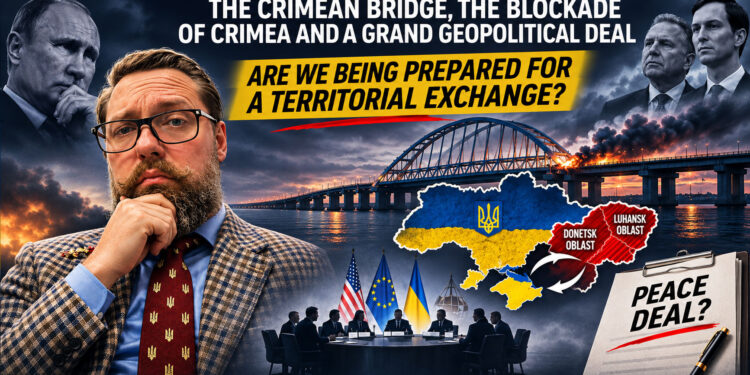
Oleksiy Shevchuk — Author’s Analysis.
Friends, I believe many people are looking far too superficially at the Crimean Bridge, the blockade of Crimea and the potential consequences of these developments.
Let us examine the situation not through the lens of emotion, but from the perspective of geopolitics, diplomacy and the logic of a major international agreement.
Against the backdrop of statements and diplomatic initiatives by Steve Witkoff and Jared Kushner concerning possible ways to end the war in Ukraine, I have arrived at a rather uncomfortable but strategically important hypothesis.
What if Putin is already contemplating giving up Crimea in exchange for international recognition of Russian control over the entirety of Donetsk and Luhansk oblasts?
Does that sound paradoxical? Perhaps. But let us consider it carefully.
Could Crimea Become a Bargaining Chip in a Major Territorial Deal?
We are accustomed to viewing Crimea as the central symbol of Putin’s imperial policy. Yet for Putin himself, territories may be less a sacred value than an instrument for achieving a specific political outcome.
The Kremlin’s response to events in the Kursk region, along with its willingness to expose Crimea to increasing military and economic isolation, gives us reason to ask at least one question: how committed is Putin to retaining every occupied territory?
Now imagine one possible negotiating scenario.
First component: Ukraine regains control over Crimea and the southern territories, including through military, economic and diplomatic pressure.
Second component: Russia demands the entirety of Donetsk and Luhansk oblasts, including areas it has been unable to occupy by military force.
Third component: International mediators propose formalizing this arrangement as the basis of a comprehensive peace agreement.
And this is where things become particularly interesting.
For Putin, such an outcome could provide a way to portray the war as having achieved concrete territorial gains. Not an abstract “special military operation,” but a concluded war after which Russia has obtained Donbas.
At the same time, international mediators could present the return of Crimea and southern Ukraine as an enormous diplomatic success.
But would this constitute a just peace? And, more importantly, would Ukraine have the legal right and political ability to accept such an arrangement?
Let me remind you that the Constitution of Ukraine does not provide for a simple political exchange of territories. Questions concerning changes to Ukraine’s territory are decided exclusively by an all-Ukrainian referendum. Even this constitutional provision does not automatically make every territorial concession lawful.
I am therefore not claiming that such a scenario has already been agreed upon. This is my geopolitical hypothesis, which should be analyzed rather than treated as an established fact.
The Blockade of Crimea: Military Pressure or Isolation of Civilians?
Now let us return to the Crimean Bridge.
When we welcome the prospect of a blockade of Crimea, we must remember that people live on the peninsula. Our citizens. Ukrainians and Crimean Tatars who have lived under occupation for years.
The military isolation of an occupying force and the humanitarian isolation of the civilian population are fundamentally different things.
We must not allow an instrument of military pressure to become a form of collective punishment against the very people Ukraine seeks to bring back.
And if international diplomacy does eventually produce a scenario for the return of Crimea, we will need to explain to Crimeans not only why we welcomed the blockade, but also how we intended to ensure their safety, supplies, rights and normal lives.
Ukraine Must Not Be the Last to Learn the Terms of a Deal
My central argument is simple.
The Crimean Bridge should not be viewed solely as an engineering structure or a military target. In a larger diplomatic game, it may be one of the elements shaping a new negotiating position.
Sometimes what society perceives as an isolated military operation may, in diplomatic terms, form part of a much broader arrangement.
Is Putin prepared to sacrifice Crimea for Donbas? We do not know.
But should Ukrainian diplomacy assess and prepare for such a scenario?
Absolutely.
Because the greatest danger in international negotiations is not a complicated agreement. The greatest danger is discovering its true terms only after everyone else has already learned them.
And one more thing. The return of Crimea cannot justify the loss of Donbas. Ukrainian territories are not bargaining chips in some grand geopolitical accounting exercise.